

Reagan Faulkner
Rated 5 out of 5Jesse and his crew are amazing to work with! He was able to get my job finished quickly and efficiently! I could not recommend him enough to help you out!
Serving Wichita, Derby, Andover, Haysville & South Central Kansas
Mon–Fri 7:00 a.m.–6:00 p.m. · Sat by appointment onlyLicense# BUS2025-11907
In-Floor Heating
Radiant floor heating is the one heating decision with a deadline: the tubing and the insulation under it go in before the concrete, and nearly everything worth knowing about it is worth knowing before then.
20+
Years Experience
All Makes
& Models
Licensed
BUS2025-11907
5.0
Residential
& Commercial
Most heating decisions can be revisited. A furnace can be replaced, a thermostat moved, a mini-split added to the room that never got comfortable. Radiant floor heating is the exception: the tubing goes into the slab, the slab is poured once, and the building keeps whatever was decided that week for as long as it stands.
Which is why the conversation about radiant floor heating in Wichita tends to arrive at one of two moments. Either somebody has a shop, a barn or a house on paper and a concrete date coming, or somebody has a heated floor that has stopped behaving the way it used to. This is written for both, in that order.
It covers what in-floor heat does well in South Central Kansas, where it is the wrong answer, what has to be settled before the pour, and what can be checked on an existing system without anybody opening a floor.
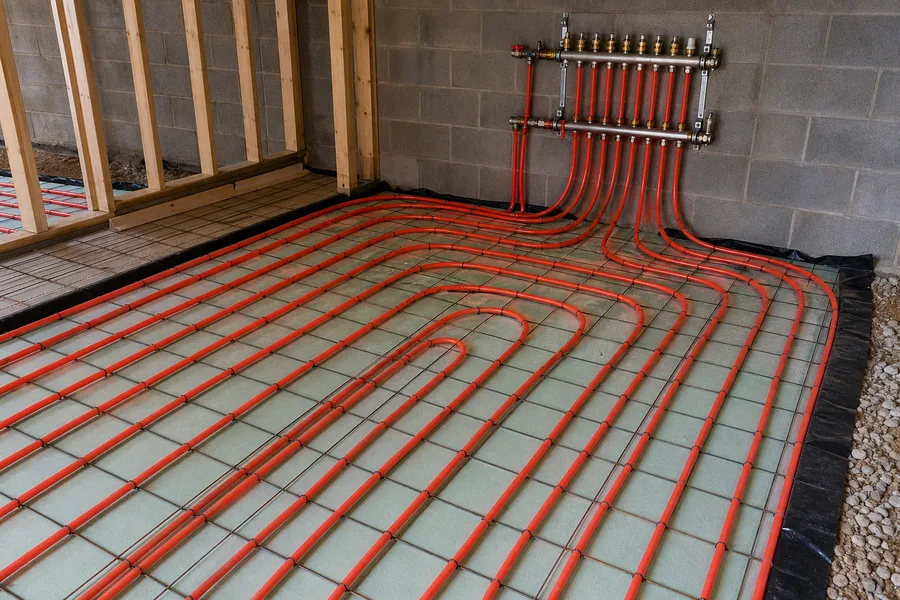
The kind that suits a slab is hydronic: loops of tubing set in the concrete, with warm water moving through them. A heat source — usually a boiler — warms the water, a circulator moves it, and the slab takes the heat up and gives it off evenly across the whole floor. The floor is the radiator.
Every loop starts and ends at a manifold on the wall, where the loops are balanced against each other and can be shut off one at a time. Under the concrete and around its edge, insulation keeps the heat coming up into the room instead of soaking down into the ground. Controls decide when the water moves and how warm it runs.
Two things follow from that arrangement, and most of this article is one or the other. The parts that wear — the heat source, the circulator, the controls, the manifold — are all on a wall where somebody can reach them. The parts nobody will ever reach again, the tubing and the insulation, have to be right on the day the concrete arrives.
The equipment is the same in every building. What changes is why somebody wants it.
A concrete floor is the coldest thing in a Kansas shop in January, and it is the thing you are standing, kneeling and lying on. Heat from overhead warms the air and collects under the roof; heat in the slab starts where the work is. Nothing blows, so nothing carries dust across a finish that is still wet.
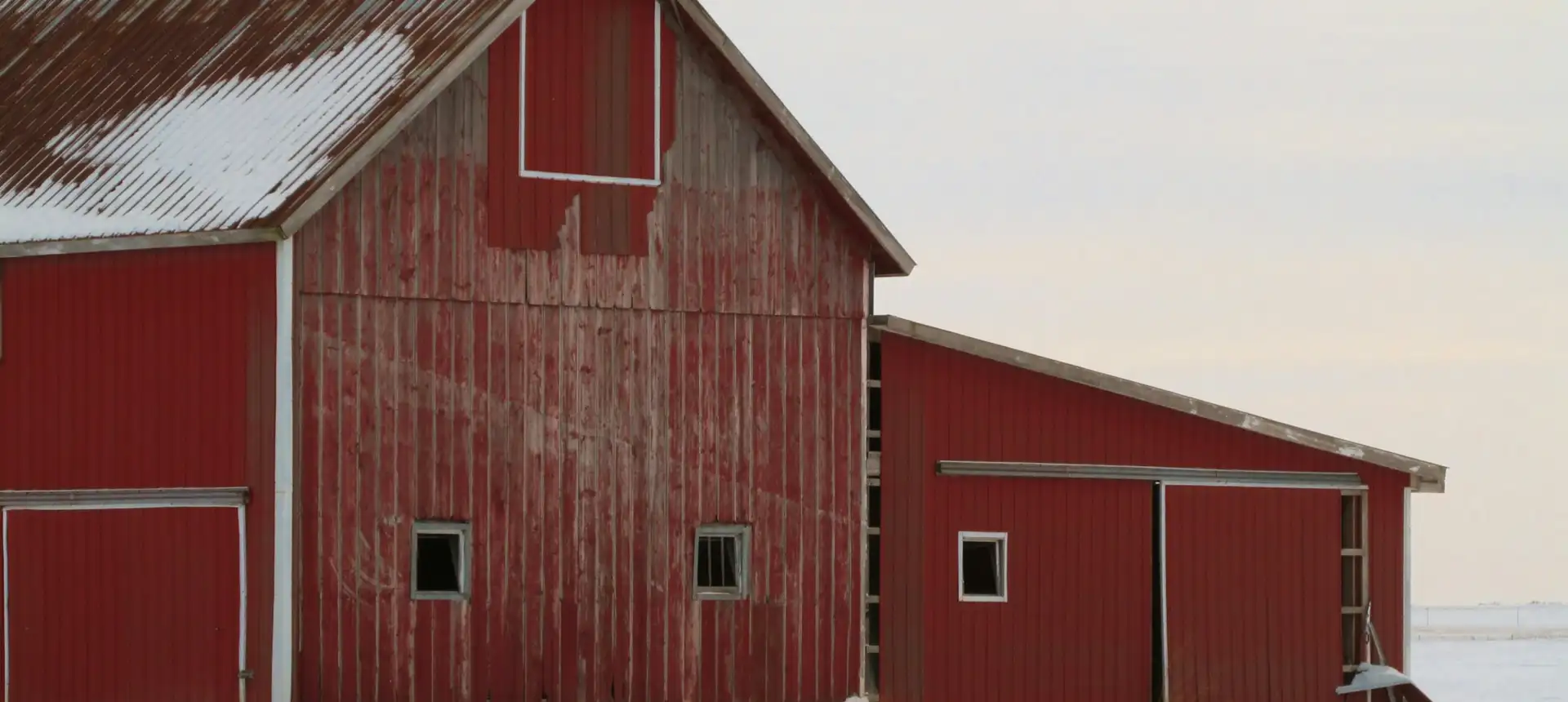
It is a natural fit for the outbuildings on acreages around Clearwater, Goddard, Andover and Douglass, where the shop often gets used harder than the house.
In a house the appeal is quieter. There is no moving air, so no draft, no register to keep the furniture off, and nothing to hear when the heat comes on. A new build on a slab, a slab-on-grade addition or a basement floor are where it goes in most simply, for the same reason as a shop: the concrete is being poured anyway.
Floor finishes matter here in a way they do not in a shop. Tile and finished concrete pass heat readily, thick carpet and pad hold it back, and some wood and vinyl products carry limits from their manufacturer that are worth reading before the flooring is ordered.
It heats and it does not cool. A Kansas summer still needs an answer, and in a slab building with no ductwork that is usually a ductless mini-split.
It also suits a building used most days far better than one used now and then. A slab takes hours to warm, not minutes, so a shop visited two Saturdays a month either holds a temperature all winter or is never warm when you arrive. And once a slab has been poured without tubing, adding it is a much bigger job than the one that was skipped — at that point a ductless system is usually the practical route.
South Central Kansas does not have one kind of winter day. It has hard cold, it has wind, and it has days that start below freezing and finish in shirtsleeves. A heated slab answers each of those differently from a furnace.
A slab is slow on purpose. It takes hours to warm and hours to cool, which is what makes it even — and what makes it lag when the weather turns quickly. On a day that swings from a hard frost to a mild afternoon, a floor heated for the morning is still giving that heat back after lunch.
That is a controls question, not a flaw. A system that reads the outdoor temperature and the slab itself handles those days far better than one that waits for the air in the room to feel cold. It is also why turning the heat down at night and back up in the morning, the habit a furnace rewards, does very little for a slab. Pick a temperature and leave it there.
Open an overhead door in January and the warm air leaves in about the time it takes to drive a truck through it. With warm-air heat, that was the heating. With a heated slab it was not: the heat is stored in the concrete and in everything sitting on it, and the air comes back up without the system starting from nothing.
Wind is the other half. It finds every gap in a metal building, and it pulls heat out through an uninsulated slab edge all winter — which is the first of the things to settle before the pour.
Water in a slab is a liability in a building that might go unheated: a shop on a second property, or a barn through a power outage in an ice storm. Whether the system runs on plain water or on a freeze-protected mix is a design decision, made at the start and checked periodically afterwards, and it is decided by how the building is actually used.
This is the part with a date on it. None of these is complicated, and all of them are far cheaper to decide on paper than to regret in concrete.
The tubing and the insulation are also the only parts that have to go in before the concrete. If the budget for the building is already spoken for, it is worth asking whether those two go in now and the heat source follows later — a slab poured without them has made the decision for you.
The one deadline
Tubing and insulation go in before the concrete. Everything else about an in-floor system can be reached, adjusted or replaced later. Those two cannot.
Before the forms are set, have an answer for:
The right time to ring us is while the building is still a drawing. The second-best time is before the forms are set.
A heated floor gives very little away. There is no blower to hear and no register to hold a hand over, so the signs are quieter than a furnace’s and they tend to arrive gradually. These are the ones worth writing down.
Things you can see, hear or feel without taking a cover off anything — all of them worth mentioning when you call:
Every one of those has more than one possible explanation, and which applies is measured, not guessed. Tell us what it is doing and when it started.
If you ever smell gas near the heat source, none of this applies. Leave the building and call the gas utility from outside.
Most of an in-floor system is behind concrete, and that is exactly why the diagnosis starts everywhere else. The heat source, the circulator, the manifold and the controls are all on the wall, and between them they account for most of what can be measured — including a good deal about the loops nobody can see.
On an in-floor call we are working through:
The conversation about concrete comes last, and only after the readings have ruled out everything on the wall.
Your first and last call
Radiant floor heating rewards the people who asked early. If there is a shop, a barn, an addition or a house on paper anywhere in the Wichita area, the useful moment to bring us in is now, while moving a manifold or adding a zone costs a pencil line. If the floor is already down and has stopped doing what it used to, the order is the same as on every job of ours: find out why first, then talk about what it needs.
More than twenty years installing and servicing heating and cooling across Wichita and South Central Kansas, residential and commercial, on all makes and models — in-floor systems in homes, shops and barns among them. Fairly priced, and you know what is involved before any work starts.
Call 316-807-1713 while the building is still a drawing.
Where this goes next
More reading
Google Reviews
Our customers talk about the same things: we show up fast, we find what’s actually wrong, and we finish when we said we would.
Reagan Faulkner
Rated 5 out of 5Jesse and his crew are amazing to work with! He was able to get my job finished quickly and efficiently! I could not recommend him enough to help you out!

Dale England
Rated 5 out of 5Jesse was great. Helped get everything all fixed up. Very professional. Highly recommend.

Michael Funke
Rated 5 out of 5Jesse came out short notice and got us back up and running and identified a few issues our previous HVAC company missed. No doubt, Arrow Heating and Air will be our "go-to" from now on.

Sarah Davis
Rated 5 out of 5Jesse is amazing! He is honest, fair and extremely reliable. He has been my hvac guy for 10+ and I highly recommend him!.

jason payne
Rated 5 out of 5Very happy with Arrow are air conditioning quit on the Friday night before this 2026 Memorial weekend. I asked a buddy who to call he gave me Jesse’s number he can out an hour later got us going for a day or so. Then came out Tuesday and replaced the A coil inspected everything and got us up and running and for a fair price. I highly recommended Arrow!

Heather
Rated 5 out of 5Jesse has taken care of my HVAC needs for many years! He is hardworking, reliable, and very knowledgeable about all things HVAC. He will treat you fairly and give you an honest opinion of what you need. I would highly recommend him for any job or repair that you may need.

Timmy Colborn
Rated 5 out of 5Arrow did a fantastic job, i was in need of new unit for our home and they took care of it right away. Not long after that they help with heatin my shop, they did an amazing job withthat as well.

Lance Bryson
Rated 5 out of 5Jesse is great. He is quick to respond and he has always been fair on pricing for repairs.

Rachel Westmoreland
Rated 5 out of 5I started using Jesse for my heat air for our investment properties. It has been nothing but positive reviews from my tenants! He has already corrected issues that would have caused problems in the summer heat AND set blower settings on some units that were never done correctly when the unit was installed! His communication has been great, always telling me what the issue is and cost to repair.

Chris Gallardo
Rated 5 out of 5Arrow does amazing work!! Installed a mini split for our attic space in Conway Springs.Small living quarters in the attic. Window AC could never keep up and was loud.The mini split made it so nice, quiet and cool. Cool enough to need blankets in the summer time!!Highly recommend!!

Brent Cleeton
Rated 5 out of 5Great turn around time and great price, and the work was phenomenal and Jesse is a super nice guy

Jessica Hall
Rated 5 out of 5Very fast and professional and very reasonable pricing, I will use them again in the future.

vecente6903
Rated 5 out of 5Quick, honest, knowledgeable, jesse is great and does great work!

Jeremy Edwards
Rated 5 out of 5Jesse is our one stop shop for our collision center regarding our paint booth and compressor. Thank you from Norris Collision Center!

elery shively
Rated 5 out of 5Great service!

Gina DeCoudres Dunlap
Rated 5 out of 5"I can't recommend Jesse highly enough! Our AC was not working properly, and he was able to come out the same day to get it back up and running. Fast, professional, and very knowledgeable. We will definitely recommend him to everyone.

Sheri
Rated 5 out of 5Very responsive, professional, knowledgeable and honest. Thanks!!!!

DOUG FAULKNER
Rated 5 out of 5Great company! Called when my a/c went down and Jesse was there within 2 hrs. Honest with very fair pricing. Didn’t try to sell me anything I didn’t need. Cleaned the outside unit and replaced the filter and it’s been working great.

Keith Simpson
Rated 5 out of 5Jesse is the best around bar none. Weather your residential or commercial he’s got you covered. Strait shooter no bs. Like is slogan says “ he’ll shoot you straight” honest and dependable. Would definitely recommend Arrow Heating and Air for all your HVAC needs

Staci DeGeer
Rated 5 out of 5I had a great experience with Arrow Heating & Air! Jesse arrived right on time, quickly diagnosed the issue, and had everything fixed efficiently. The problem turned out to be a bad capacitor, and fortunately, he had the replacement part stocked on his truck, so I was back up and running in no time.What really stood out was that Jesse went above and beyond by taking the time to clean off my outdoor air conditioning unit to help it continue running efficiently. He was knowledgeable, capable, professional, and clearly takes pride in his work.I highly recommend Arrow Heating & Air for anyone needing fast, reliable, and high-quality HVAC service!

Clancy Leibham
Rated 5 out of 5Arrived early and found the problem within 5 min. Very knowledgeable! Will use again!

Kimba
Rated 5 out of 5Arrow heating and air is the only HVAC company our family in Derby will ever use. From troubleshooting to complete system replacement, Jesse does what he promises, right on time at a fair price. Thank you!

Austin Blake
Rated 5 out of 5Arrow Heating and Air Conditioning is my first and last call for any issue I run into with our HVAC system. Knowledge and skill is unparalleled. You save money when you work with someone that knows what they are doing and eliminate the guesswork. Thank you!

Rob Brown
Rated 5 out of 5Top notch work, very fair price and fast service.
Get started
Tell us what your system is doing and we'll tell you what it needs.
Or just call
316-807-1713Arrow Heating and Air Conditioning, LLC · License# BUS2025-11907