


Reagan Faulkner
Rated 5 out of 5Jesse and his crew are amazing to work with! He was able to get my job finished quickly and efficiently! I could not recommend him enough to help you out!
Serving Wichita, Derby, Andover, Haysville & South Central Kansas
Mon–Fri 7:00 a.m.–6:00 p.m. · Sat by appointment onlyLicense# BUS2025-11907
Refrigeration
A walk-in that has drifted a few degrees is a repair. A walk-in that has been drifting since Friday is a repair plus whatever was on the shelves — and most of the difference is how early somebody read the number.
20+
Years Experience
All Makes
& Models
Licensed
BUS2025-11907
5.0
Residential
& Commercial
You open up at six and the box reads forty-six. It was thirty-seven on Friday. Somewhere between those two numbers is a decision about a delivery, a prep list and whatever is on the second shelf, and it has to be made before the first ticket comes in.
Here is the useful thing about that morning: a walk-in cooler that is not cooling properly almost never failed all at once. It drifts. That drift is a window, and the difference between an inconvenient Tuesday and an expensive one is whether anybody read the number while the window was open.
What follows is the conversation we have on the phone with Wichita-area restaurants, delis, bars and small groceries — what you can establish in ten minutes, what Kansas weather does to the half of the system that lives outdoors, and what we measure when we get there.
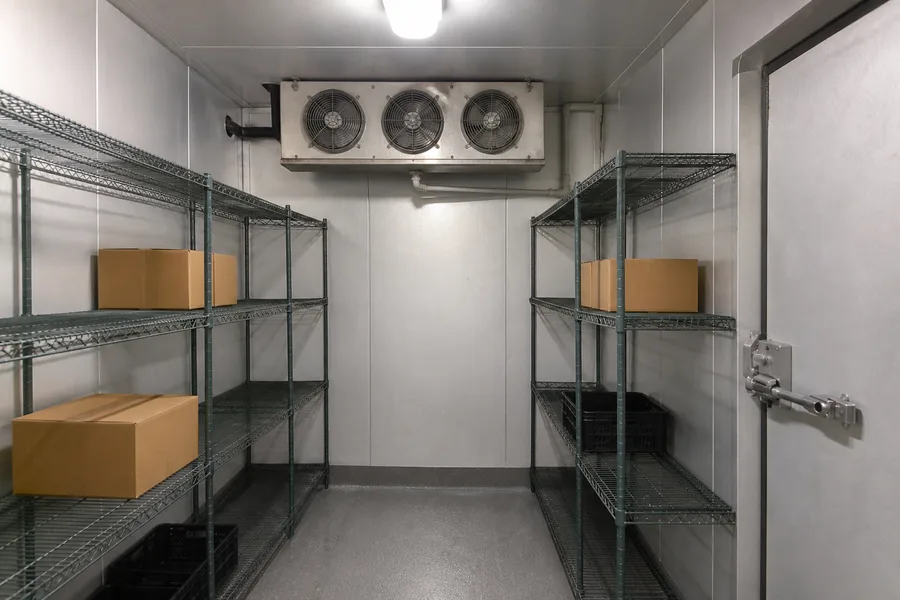
Four parts and a room. Outside — on the roof, on a pad, sometimes hung on a wall — sits the condensing unit: a compressor, a coil and a fan. Inside the box, high on the back wall, is the evaporator: another coil, more fans, and the thing actually cooling the air you feel walking in. Refrigerant lines run between them, and controls and a defrost cycle decide when everything runs.
The fourth part is the box itself, and nobody counts it as part of the system: insulated panels, a door, a gasket, a sweep and a closer. That shell does as much work as the compressor, and unlike the compressor it has no gauge on it.
The principle underneath it is worth holding on to, because every section below follows from it. Refrigeration does not make cold — it moves heat, picking it up at the evaporator inside the box and dropping it at the condenser outside. So the machine can only take heat out of your product as fast as it sheds heat into the air behind your building. Interfere with the second half and the first half stops, in the room where the food is.
The whole principle
Refrigeration moves heat rather than making cold. Whatever stops the condenser dumping heat outside is what stops the box holding temperature inside.
None of this requires taking a panel off anything, and that is the line: everything below you can see, hear or read off a display, and nothing below means opening an electrical enclosure or putting a hand near a fan. Do it before you ring — it changes what we bring and how quickly we get to an answer.
Worth establishing before you pick up the phone:
That last one is not a formality. Plenty of the walk-in calls we take around Wichita come back to something that changed in the room, not something that failed in the machine.
Refrigeration is sized against the conditions it works in, and ours are not gentle. Wichita spends much of July and August in the nineties, runs over a hundred regularly, then does single digits in January — and the condenser rejects heat into all of it.
The first hot fortnight
A box that has held temperature for years and starts drifting in the first heat wave usually did not change. The air its condenser is breathing did.
The hotter the outdoor air, the harder that job. A unit on a flat black roof in August breathes air several degrees above whatever the forecast said, and one tucked into a corner with walls on two sides is partly breathing its own exhaust.
Which is why a box fine for six years starts drifting in the middle of a heat wave rather than on the day it went in. Nothing about the machine changed; the air around it did, and equipment with margin to spare in May can be at its limit by the first genuinely hot fortnight.
A condenser coil is a dense stack of fins with air forced through it, and here that air carries cottonwood in June, field dust most of the year, and whatever the wind lifted off dry ground. What does not pass through the fins stays on the face of them.
A matted coil is the most preventable condition on the whole system and the likeliest to sit there unnoticed, precisely because the unit is on a roof or behind the building where nobody walks past. Clearance counts as much as cleaning — pallets, stock and new landscaping have all taken it away on jobs we have been called to.
A cooler still runs in January, and a condenser designed to reject heat into ninety-five degree air behaves differently at ten. Systems meant to run year round carry controls for that, and whether yours has them is better established in October than during a cold snap.
A cooler and a freezer are the same idea run at different temperatures, and very nearly everything that separates them is what happens to moisture.
In a cooler, moisture condensing on the evaporator runs into a pan and away down a drain. In a freezer it freezes — on the coil, in the pan, in the drain line, around the door. So every freezer runs a defrost cycle and carries heat where a cooler does not: the drain line, the door frame, the sweep. Small components, large consequences, and failure modes a cooler does not have.
Some ice in a freezer is normal and some is not, and telling those apart is not your job. Where it is and whether it is new is worth reporting; what it means is a measurement, and ours to take.
Gaskets harden, tear at the corners and stop meeting the frame. Closers weaken. Hinges drop and the door stops pulling square. Strip curtains get torn, cut short or tied back. None of it is dramatic, and all of it is a hole in the insulation you paid for, open every hour you are.
And in a working kitchen doors get propped — a long delivery, a two-person job, a cart that will not hold it. The point is not that it should never happen, but that the refrigeration was sized assuming it mostly does not, and a box open twenty minutes on an August afternoon has real work ahead of it to get back down.
This is the list worth pinning inside the office door — because the people likeliest to notice any of it are the ones opening the box forty times a shift, not the one reading the logs.
Things you or your staff can see, hear or feel — all of them worth reporting when you call:
Every one of those has several possible explanations, and which applies gets measured rather than guessed. Tell us what it is doing and when it started.
Called while the box is drifting, this is a repair. Called after, it is a repair plus an inventory — and the second number is the larger one.
A diagnosis on refrigeration is not a look and an opinion. It is readings taken off a running system and compared against what that equipment should be doing — the only way to separate conditions that all present as a box which will not come down.
On a walk-in call we are working through:
None of this asks you to know the answer before we arrive. It asks whoever comes out to measure rather than guess, and to tell you what they found.
Side by side
Three ways businesses genuinely handle walk-in refrigeration, set against each other on the things that differ. We are not going to pretend that running one to failure is never the right answer — sometimes it is, and the table says where.
| Compared on | Planned serviceScheduled visits at an interval set by the box and by what it holds. | Call at the first driftNo schedule. You call the morning the numbers move. | Run it until it stopsNo schedule, and no call until the box is out of temperature. |
|---|---|---|---|
| What you are actually buying | Planned serviceCoils cleaned, defrost and controls checked, doors and gaskets gone over, and readings taken while nothing is wrong — which is what makes the next set of readings mean something. | Call at the first driftA diagnosis when you need one and nothing you do not. | Run it until it stopsNothing — until you are buying a repair under the worst possible conditions for making decisions about one. |
| When you find out there is a problem | Planned serviceUsually before the box drifts. Not always: a compressor can still fail on a Tuesday, and no schedule claims otherwise. | Call at the first driftWhen the box tells you — which is early enough, but only if somebody is genuinely reading it every day. | Run it until it stopsWhen the product is already warm, and typically on the morning you can least afford it. |
| What is at risk on the shelves | Planned serviceLeast. The conditions that put product at risk are mostly slow ones, and a schedule is good at catching slow. | Call at the first driftSome, and how much depends entirely on how fast the drift is and how quickly it gets noticed. | Run it until it stopsAll of it. This is the option where the refrigeration bill is the smaller of the two numbers. |
| Running cost through a Kansas summer | Planned serviceLowest. A clean condenser and a door that seals are the two biggest levers on what the system draws in August. | Call at the first driftMiddling. Nothing is being kept clean, so the system spends months working harder than it has to. | Run it until it stopsHighest. A neglected condenser draws more power for less cooling every month it stays that way. |
| Effect on equipment life | Planned serviceLongest. Most of what shortens it is months of running hard against a dirty coil or a door that does not close. | Call at the first driftShorter than planned service, considerably longer than running it to failure. | Run it until it stopsShortest. Parts that would have been a repair become the reason the whole unit gets replaced. |
| Where it genuinely makes sense | Planned serviceAny box holding product you would not want to write off, and effectively every freezer. | Call at the first driftA cooler holding low-value stock in an operation where temperatures are actually checked and logged daily. | Run it until it stopsAn empty backup box, a seasonal cooler that holds nothing for half the year, or a unit already scheduled for replacement. |
The real split is not between careful operators and careless ones. It is between boxes whose failure costs a service call and boxes whose failure costs a service call plus a delivery, a night of stock and the morning after it — and most kitchens have one of each.
Your first and last call
A walk-in that has moved a few degrees is a diagnosis. A walk-in that has been out since Friday is a diagnosis and an inventory. The window between those two is the whole reason to ring early, and nothing is lost by having us look at a box that turns out to be fine.
More than twenty years on commercial refrigeration and commercial HVAC across Wichita and South Central Kansas — walk-in coolers and freezers, rooftop units, boilers, chillers, make-up air and paint booths, on all makes and models. Fairly priced, with the same approach on every job: you find out what is wrong and what your options are before any work starts.
Call 316-807-1713 and tell us what the box is reading.
Where this goes next
More reading
Google Reviews
Our customers talk about the same things: we show up fast, we find what’s actually wrong, and we finish when we said we would.
Reagan Faulkner
Rated 5 out of 5Jesse and his crew are amazing to work with! He was able to get my job finished quickly and efficiently! I could not recommend him enough to help you out!

Dale England
Rated 5 out of 5Jesse was great. Helped get everything all fixed up. Very professional. Highly recommend.

Michael Funke
Rated 5 out of 5Jesse came out short notice and got us back up and running and identified a few issues our previous HVAC company missed. No doubt, Arrow Heating and Air will be our "go-to" from now on.

Sarah Davis
Rated 5 out of 5Jesse is amazing! He is honest, fair and extremely reliable. He has been my hvac guy for 10+ and I highly recommend him!.

jason payne
Rated 5 out of 5Very happy with Arrow are air conditioning quit on the Friday night before this 2026 Memorial weekend. I asked a buddy who to call he gave me Jesse’s number he can out an hour later got us going for a day or so. Then came out Tuesday and replaced the A coil inspected everything and got us up and running and for a fair price. I highly recommended Arrow!

Heather
Rated 5 out of 5Jesse has taken care of my HVAC needs for many years! He is hardworking, reliable, and very knowledgeable about all things HVAC. He will treat you fairly and give you an honest opinion of what you need. I would highly recommend him for any job or repair that you may need.

Timmy Colborn
Rated 5 out of 5Arrow did a fantastic job, i was in need of new unit for our home and they took care of it right away. Not long after that they help with heatin my shop, they did an amazing job withthat as well.

Lance Bryson
Rated 5 out of 5Jesse is great. He is quick to respond and he has always been fair on pricing for repairs.

Rachel Westmoreland
Rated 5 out of 5I started using Jesse for my heat air for our investment properties. It has been nothing but positive reviews from my tenants! He has already corrected issues that would have caused problems in the summer heat AND set blower settings on some units that were never done correctly when the unit was installed! His communication has been great, always telling me what the issue is and cost to repair.

Chris Gallardo
Rated 5 out of 5Arrow does amazing work!! Installed a mini split for our attic space in Conway Springs.Small living quarters in the attic. Window AC could never keep up and was loud.The mini split made it so nice, quiet and cool. Cool enough to need blankets in the summer time!!Highly recommend!!

Brent Cleeton
Rated 5 out of 5Great turn around time and great price, and the work was phenomenal and Jesse is a super nice guy

Jessica Hall
Rated 5 out of 5Very fast and professional and very reasonable pricing, I will use them again in the future.

vecente6903
Rated 5 out of 5Quick, honest, knowledgeable, jesse is great and does great work!

Jeremy Edwards
Rated 5 out of 5Jesse is our one stop shop for our collision center regarding our paint booth and compressor. Thank you from Norris Collision Center!

elery shively
Rated 5 out of 5Great service!

Gina DeCoudres Dunlap
Rated 5 out of 5"I can't recommend Jesse highly enough! Our AC was not working properly, and he was able to come out the same day to get it back up and running. Fast, professional, and very knowledgeable. We will definitely recommend him to everyone.

Sheri
Rated 5 out of 5Very responsive, professional, knowledgeable and honest. Thanks!!!!

DOUG FAULKNER
Rated 5 out of 5Great company! Called when my a/c went down and Jesse was there within 2 hrs. Honest with very fair pricing. Didn’t try to sell me anything I didn’t need. Cleaned the outside unit and replaced the filter and it’s been working great.

Keith Simpson
Rated 5 out of 5Jesse is the best around bar none. Weather your residential or commercial he’s got you covered. Strait shooter no bs. Like is slogan says “ he’ll shoot you straight” honest and dependable. Would definitely recommend Arrow Heating and Air for all your HVAC needs

Staci DeGeer
Rated 5 out of 5I had a great experience with Arrow Heating & Air! Jesse arrived right on time, quickly diagnosed the issue, and had everything fixed efficiently. The problem turned out to be a bad capacitor, and fortunately, he had the replacement part stocked on his truck, so I was back up and running in no time.What really stood out was that Jesse went above and beyond by taking the time to clean off my outdoor air conditioning unit to help it continue running efficiently. He was knowledgeable, capable, professional, and clearly takes pride in his work.I highly recommend Arrow Heating & Air for anyone needing fast, reliable, and high-quality HVAC service!

Clancy Leibham
Rated 5 out of 5Arrived early and found the problem within 5 min. Very knowledgeable! Will use again!

Kimba
Rated 5 out of 5Arrow heating and air is the only HVAC company our family in Derby will ever use. From troubleshooting to complete system replacement, Jesse does what he promises, right on time at a fair price. Thank you!

Austin Blake
Rated 5 out of 5Arrow Heating and Air Conditioning is my first and last call for any issue I run into with our HVAC system. Knowledge and skill is unparalleled. You save money when you work with someone that knows what they are doing and eliminate the guesswork. Thank you!

Rob Brown
Rated 5 out of 5Top notch work, very fair price and fast service.
Get started
Tell us what your system is doing and we'll tell you what it needs.
Or just call
316-807-1713Arrow Heating and Air Conditioning, LLC · License# BUS2025-11907