

Reagan Faulkner
Rated 5 out of 5Jesse and his crew are amazing to work with! He was able to get my job finished quickly and efficiently! I could not recommend him enough to help you out!
Serving Wichita, Derby, Andover, Haysville & South Central Kansas
Mon–Fri 7:00 a.m.–6:00 p.m. · Sat by appointment onlyLicense# BUS2025-11907
Make-Up Air
Every cubic foot of air a hood or an extraction fan pulls out of a building comes back in somewhere, and in a Kansas January the only question is whether it comes back heated, through the make-up air unit, or cold, through every door and gap in the place.
20+
Years Experience
All Makes
& Models
Licensed
BUS2025-11907
5.0
Residential
& Commercial
A make-up air unit in winter has a harder job than at any other time of year. In July it only has to put back the air your hood, your welding extraction or your paint booth is pulling out. In January it has to put that air back warm, and the gap between the air outside and the room it is going into is the widest it will be all year.
Most owners never think about the unit until it falls behind. The line gets cold every time the hood comes on, the back door fights you, or somebody finds the switch that stops the cold blast and leaves it off — which feels like a fix and is not one.
This is written for Wichita-area restaurant owners, kitchen managers and shop owners heading into the cold months. It covers what the unit is doing, what a building out of balance feels like, why South Central Kansas weather is hard on the heating side, what you can check yourself, and what a technician measures.
A building can only push out as much air as it lets in. A kitchen hood, a welding fume extractor or a paint booth exhaust fan moves a great deal of air outdoors, far more than ordinary heating and cooling equipment is built to replace. The make-up air unit is the machine that brings that air back: a fan, a filter, a set of dampers and, in a cold climate, a heater, usually on the roof or on a stand beside the building.
In winter the heater is the whole story. Outdoor air drawn into a kitchen in January is the coldest air the building will see, and the unit’s job is to warm it on the way in so the people standing under the supply never notice it arriving. Most heated units are gas-fired; some run a hot-water coil off a boiler, and some use electric heat.
The unit is also tied to the exhaust it serves. In most installations the two are interlocked, so turning the hood on calls the make-up air unit on with it. That pairing is the reason a make-up air unit gets blamed for a cold kitchen and switched off, and the reason switching it off makes a different problem.
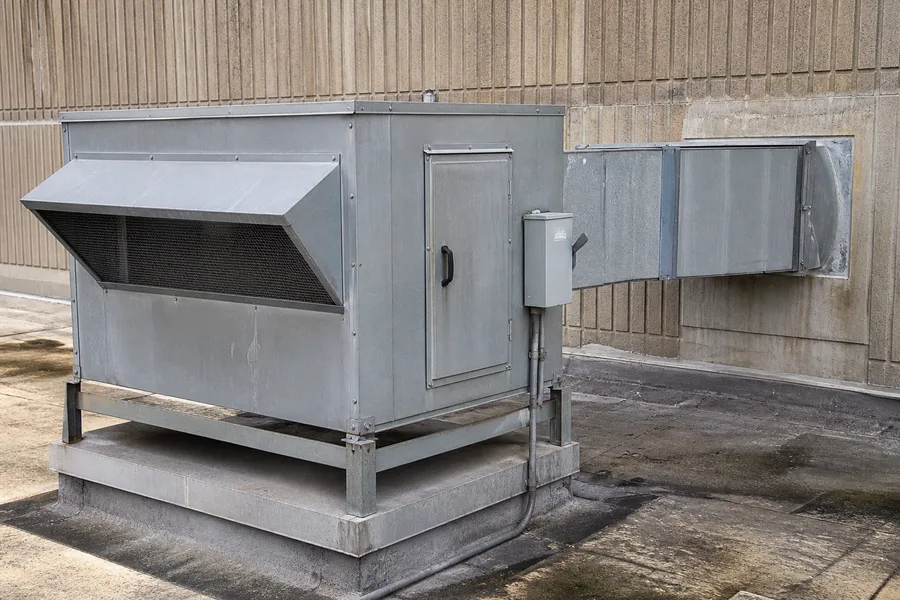
The exhaust does not stop pulling because the make-up air unit has stopped keeping up. The air it removes is replaced anyway, through whatever opening is easiest: under doors, around windows, down a flue, through the gap above the ceiling. The building goes negative, and in winter every one of those openings is letting in outdoor air nobody has warmed.
What that looks like depends on what the building is for.
The cooks feel it first: a cold draft along the line whenever the hood runs, or a blast of cold air from the supply when the heat is not keeping pace. Front-of-house feels it next, at the entrance door that whistles or pulls hard against the people trying to open it.
The hood itself can stop clearing smoke and steam the way it used to, because it is now competing with the building for air. And gas cooking equipment, water heaters and other appliances that vent through a flue are designed to do so in a building that is not straining against them. When any of that starts, it is worth a call rather than a workaround.
In a fabrication shop the extraction that keeps fumes off the floor is the same fan pulling cold air in at the overhead door. A unit that is not heating turns the bay nearest the supply into the coldest place in the building, and people start propping doors and unplugging things to make it bearable.
A heated paint booth is a make-up air system in its own right: the booth’s supply heats the air it brings in so the finish goes on and cures the way it should. When that heat falls behind in January, the booth shows it in production before anybody has looked at the burner.
Wichita does not have one kind of winter day, and a make-up air unit feels every kind.
Most of the autumn, the heating section of a make-up air unit barely runs. Then the first genuinely cold morning arrives and it is asked for everything at once, with the hood on high and a full kitchen behind it. A burner, an igniter or a control that has been idle since March gets its first real test on the busiest day of the week. That is the argument for looking at it in October rather than in December.
A South Central Kansas day can start well below freezing and finish mild. The heating side of the unit has to follow that the whole way, giving a lot of heat at seven in the morning and very little by three. How well it tracks depends on how the controls read the air and how the burner adjusts, both of which drift with time and both of which are checked with instruments.
The intake hood faces the weather. Wind finds it, drifting snow and freezing rain can build up on it, and the cottonwood fluff of early summer and the leaves of autumn are often still sitting in the filters when winter arrives. An intake that cannot breathe is a unit that cannot keep up, however well the rest of it works.
You do not need to open the unit to learn a good deal about it. Most of what is worth knowing before winter can be seen, heard or felt from the kitchen floor, the shop floor or a safe roof access.
All of these are worth writing down and mentioning when you call:
Every one of those has more than one possible explanation, and which one applies is measured, not guessed. Tell us what the building is doing and when it started.
If you ever smell gas near the unit or the cooking line, none of this applies. Leave the building and call the gas utility from outside.
A pre-season visit is mostly about the heating section, because that is the part that has sat unused all summer and the part the building depends on in January. The fan and filter side gets its share too, because a heater that cannot move air cannot deliver heat.
On a make-up air unit before winter, we are working through:
You hear what we found and what it means before any work starts, including the times the answer is a filter and an adjustment rather than a part.
A make-up air unit is easiest to forget of anything on the roof, because it does its job quietly and nobody sees it. It earns a place on the same schedule as the rest of the building’s equipment, timed so that the heating side is looked at in the autumn, before it carries the winter.
We work on quarterly, semi-annual and annual schedules, and what sets the interval is how hard the exhaust runs and what a cold or out-of-balance building costs the operation. A kitchen running a hood twelve hours a day is a different machine from a shop that welds a few afternoons a week, even if the two units carry the same nameplate.
If the building also has rooftop units, a boiler or walk-in refrigeration, it is worth planning them together. One visit can cover the whole roof, and the same readings that tell us about the make-up air tell us about the equipment working beside it.
Side by side
There are three ways a make-up air unit can deal with winter air, and the first useful thing to know about your own is which one it is. It is written on the nameplate. This is how the three differ in a Kansas winter.
| Compared on | UntemperedA fan, filters and dampers. No heater. | Direct-firedA gas burner in the airstream heats the air on its way in. | Indirect-firedA burner fires into a heat exchanger; the supply air passes over it. |
|---|---|---|---|
| How the incoming air is heated | UntemperedIt is not. Outdoor air comes in at outdoor temperature. | Direct-firedDirectly, by a burner the supply air passes through. | Indirect-firedIndirectly, across a heat exchanger, the way a furnace heats a house. |
| Where the combustion goes | UntemperedNowhere. There is no burner. | Direct-firedInto the supply air, which is why these units prove airflow before they fire and carry safeties around it. | Indirect-firedOut through a flue. The supply air never touches the flame. |
| What a Kansas January feels like with it | UntemperedCold at the supply whenever the exhaust runs, unless something else in the building is heating that air. | Direct-firedWarm supply air whenever the burner is keeping pace, and quick to respond as the weather swings. | Indirect-firedWarm supply air like a direct-fired unit, with a heat exchanger and a flue that both need looking after. |
| Where it is usually found | UntemperedSpaces where the exhaust runs lightly or briefly, or where the room’s own heating is sized to absorb the incoming air. | Direct-firedKitchens, shops and warehouses replacing large volumes of air, where the codes in force allow it. | Indirect-firedSpaces where combustion products should not go into the supply air. |
| What a pre-winter visit concentrates on | UntemperedThe fan, belts, filters, dampers and the interlock with the exhaust. | Direct-firedBurner, ignition and flame safeguard, gas pressure, airflow proving, and the discharge temperature control. | Indirect-firedBurner, heat exchanger, flue and venting, combustion, and the controls. |
Some heated units use a hot-water coil off a boiler or electric heat instead of a burner. Same job, different equipment, and the same reason to look at it before winter.
Your first and last call
A make-up air unit that is going to struggle in January is usually giving something away in October, if anybody is listening for it. If your kitchen or shop anywhere in the Wichita area goes cold, drafty or smoky when the exhaust runs, or you simply do not know when the unit on the roof was last looked at, ring us. The order is the same as on every job of ours: find out what is happening first, then talk about what it needs.
More than twenty years installing and servicing heating and cooling across Wichita and South Central Kansas, residential and commercial, on all makes and models — make-up air units, paint booths, rooftop units, boilers, chillers and walk-in refrigeration among them. Fairly priced, and you know what is involved before any work starts.
Call 316-807-1713 before the first cold morning, not after it.
Where this goes next
More reading
Google Reviews
Our customers talk about the same things: we show up fast, we find what’s actually wrong, and we finish when we said we would.
Reagan Faulkner
Rated 5 out of 5Jesse and his crew are amazing to work with! He was able to get my job finished quickly and efficiently! I could not recommend him enough to help you out!

Dale England
Rated 5 out of 5Jesse was great. Helped get everything all fixed up. Very professional. Highly recommend.

Michael Funke
Rated 5 out of 5Jesse came out short notice and got us back up and running and identified a few issues our previous HVAC company missed. No doubt, Arrow Heating and Air will be our "go-to" from now on.

Sarah Davis
Rated 5 out of 5Jesse is amazing! He is honest, fair and extremely reliable. He has been my hvac guy for 10+ and I highly recommend him!.

jason payne
Rated 5 out of 5Very happy with Arrow are air conditioning quit on the Friday night before this 2026 Memorial weekend. I asked a buddy who to call he gave me Jesse’s number he can out an hour later got us going for a day or so. Then came out Tuesday and replaced the A coil inspected everything and got us up and running and for a fair price. I highly recommended Arrow!

Heather
Rated 5 out of 5Jesse has taken care of my HVAC needs for many years! He is hardworking, reliable, and very knowledgeable about all things HVAC. He will treat you fairly and give you an honest opinion of what you need. I would highly recommend him for any job or repair that you may need.

Timmy Colborn
Rated 5 out of 5Arrow did a fantastic job, i was in need of new unit for our home and they took care of it right away. Not long after that they help with heatin my shop, they did an amazing job withthat as well.

Lance Bryson
Rated 5 out of 5Jesse is great. He is quick to respond and he has always been fair on pricing for repairs.

Rachel Westmoreland
Rated 5 out of 5I started using Jesse for my heat air for our investment properties. It has been nothing but positive reviews from my tenants! He has already corrected issues that would have caused problems in the summer heat AND set blower settings on some units that were never done correctly when the unit was installed! His communication has been great, always telling me what the issue is and cost to repair.

Chris Gallardo
Rated 5 out of 5Arrow does amazing work!! Installed a mini split for our attic space in Conway Springs.Small living quarters in the attic. Window AC could never keep up and was loud.The mini split made it so nice, quiet and cool. Cool enough to need blankets in the summer time!!Highly recommend!!

Brent Cleeton
Rated 5 out of 5Great turn around time and great price, and the work was phenomenal and Jesse is a super nice guy

Jessica Hall
Rated 5 out of 5Very fast and professional and very reasonable pricing, I will use them again in the future.

vecente6903
Rated 5 out of 5Quick, honest, knowledgeable, jesse is great and does great work!

Jeremy Edwards
Rated 5 out of 5Jesse is our one stop shop for our collision center regarding our paint booth and compressor. Thank you from Norris Collision Center!

elery shively
Rated 5 out of 5Great service!

Gina DeCoudres Dunlap
Rated 5 out of 5"I can't recommend Jesse highly enough! Our AC was not working properly, and he was able to come out the same day to get it back up and running. Fast, professional, and very knowledgeable. We will definitely recommend him to everyone.

Sheri
Rated 5 out of 5Very responsive, professional, knowledgeable and honest. Thanks!!!!

DOUG FAULKNER
Rated 5 out of 5Great company! Called when my a/c went down and Jesse was there within 2 hrs. Honest with very fair pricing. Didn’t try to sell me anything I didn’t need. Cleaned the outside unit and replaced the filter and it’s been working great.

Keith Simpson
Rated 5 out of 5Jesse is the best around bar none. Weather your residential or commercial he’s got you covered. Strait shooter no bs. Like is slogan says “ he’ll shoot you straight” honest and dependable. Would definitely recommend Arrow Heating and Air for all your HVAC needs

Staci DeGeer
Rated 5 out of 5I had a great experience with Arrow Heating & Air! Jesse arrived right on time, quickly diagnosed the issue, and had everything fixed efficiently. The problem turned out to be a bad capacitor, and fortunately, he had the replacement part stocked on his truck, so I was back up and running in no time.What really stood out was that Jesse went above and beyond by taking the time to clean off my outdoor air conditioning unit to help it continue running efficiently. He was knowledgeable, capable, professional, and clearly takes pride in his work.I highly recommend Arrow Heating & Air for anyone needing fast, reliable, and high-quality HVAC service!

Clancy Leibham
Rated 5 out of 5Arrived early and found the problem within 5 min. Very knowledgeable! Will use again!

Kimba
Rated 5 out of 5Arrow heating and air is the only HVAC company our family in Derby will ever use. From troubleshooting to complete system replacement, Jesse does what he promises, right on time at a fair price. Thank you!

Austin Blake
Rated 5 out of 5Arrow Heating and Air Conditioning is my first and last call for any issue I run into with our HVAC system. Knowledge and skill is unparalleled. You save money when you work with someone that knows what they are doing and eliminate the guesswork. Thank you!

Rob Brown
Rated 5 out of 5Top notch work, very fair price and fast service.
Get started
Tell us what your system is doing and we'll tell you what it needs.
Or just call
316-807-1713Arrow Heating and Air Conditioning, LLC · License# BUS2025-11907